Extracellular Vesicles: A Revolution in Membrane Protein Targeting
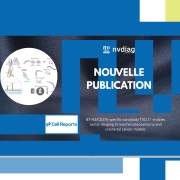
New data published by the Laboratory of Macromolecular Systems Engineering (LISM) and the Paris Institute of Ecology and Environmental Sciences (iEES-Paris) validate a unique expertise in generating nanobodies (VHH) against complex membrane targets.
A Collaboration of Excellence Driving Innovation
A major study, published in 2026 in the Journal of Extracellular Biology, validates a unique expertise and know-how for generating nanobodies from extracellular vesicles—a technology at the heart of the LabCom NVDIAG’s activities. This work is the result of a synergy between LISM (CNRS / Aix-Marseille University) and iEES-Paris (INRAE / Sorbonne University / CNRS / IRD / UPEC / Université Paris Cité). The project was coordinated by Alain Roussel (LISM) and Josiane Kassis-Sahyoun (LISM/iEES-Paris), in collaboration with Emmanuelle Jacquin-Joly (iEES-Paris).
The Scientific Challenge: « Taming » Membrane Proteins
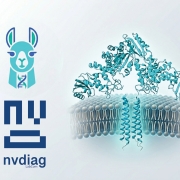
Membrane proteins are key targets in modern medicine and biology, but their natural hydrophobicity makes them extremely challenging to study. To overcome this obstacle, researchers use extracellular vesicles (EVs) as biological « display platforms. » Expressing the target protein directly on the surface of these lipid bubbles preserves its natural structure, offering a decisive advantage: target preparation in just one week, with optimal stability and native conformation.
A Biocontrol Objective: Disrupting Pest Reproduction
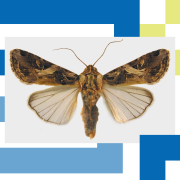
In this study, the target protein is SNMP1, a key receptor involved in the detection of sex pheromones in the pest insect Spodoptera littoralis. The goal is to develop nanobodies capable of blocking this receptor to disrupt chemical communication between insects. By preventing mating, this approach offers an innovative and environmentally friendly biocontrol strategy to limit the reproduction of pest populations in agriculture.
Technological Innovation: The « Multi-Layer » Strategy
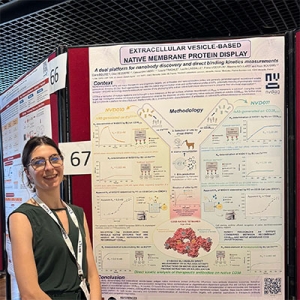
The major contribution of this work lies in the development of a multi-layer anchoring strategy. By co-expressing a universal anchor protein (ALFA-ACE2) with the target, EVs can be easily immobilized on various surfaces such as ELISA plates or biosensors. This method enabled the isolation of nano-antibodies with exceptional nanomolar affinity (down to 0.617 nM), characterized using cutting-edge Bio-Layer Interferometry (BLI) technology.
Experimental Validation for Future NVDIAG LabCom Developments
While demonstrated on an insect receptor, this technology drives NVDIAG’s human health program:
- Reliability: EVs provide a native environment under physiological membrane conditions, unlike detergents and other biochemical techniques used for extracting and stabilizing membrane proteins.
- Guaranteed Specificity: The multi-layer technology ensures specific anchoring and secures the selection of nanobodies against original epitopes.
- Universal Platform: The approach is currently being validated for a wide range of human therapeutic and diagnostic targets.
This work was supported by the French National Research Agency (ANR) (projects ANR-20-CE20-0003-01 & 02) and benefited from the infrastructure of the Laboratory of Architecture and Function of Biological Macromolecules (AFMB) and the French Infrastructure for Integrated Structural Biology (FRISBI).
—————————–VERSION FRANÇAISE—————————–
Les Vésicules Extracellulaires, une révolution pour le ciblage des protéines Membranaires
De nouvelles données publiées par le Laboratoire d’Ingénierie des Systèmes Macromoléculaires (LISM) et l’Institut d’écologie et des sciences de l’environnement de Paris (IEES-Paris) valide un savoir-faire unique pour la génération de nano-anticorps (VHH) contre des cibles membranaires complexes.
Une collaboration d’excellence au service de l’innovation
Une étude publiée en 2026 dans Journal of Extracellular Biology, valide un savoir-faire et une expertise uniques pour la génération de nano-anticorps à partir de vésicules extracellulaires, une technologie au cœur de l’activité du LabCom NVDIAG. Fruit d’une synergie entre le LISM (CNRS / Aix-Marseille Université) et l’iEES-Paris (INRAE / Sorbonne Université / CNRS / IRD / UPEC / Université Paris Cité), ce travail a été coordonné par Alain Roussel (LISM) et Josiane Kassis-Sahyoun (LISM/iEES-Paris), en collaboration avec Emmanuelle Jacquin-Joly (iEES-Paris).
Le défi scientifique : « apprivoiser » les protéines membranaires
Les protéines membranaires sont les cibles prioritaires de la médecine et de la biologie moderne, mais leur hydrophobie naturelle rend leur étude extrêmement complexe. Pour franchir cet obstacle, les chercheurs utilisent les vésicules extracellulaires (EVs) comme « présentoirs » biologiques. L’expression de la protéine cible directement à la surface de ces bulles lipidiques, permet de préserver la structure naturelle, offrant un avantage décisif : une préparation de cible en une semaine seulement, avec une stabilité et une conformité native optimales.
Un objectif de biocontrôle : perturber la reproduction des ravageurs
Dans ce travail, la cible choisie est la protéine SNMP1, un récepteur clé impliqué dans la détection des phéromones sexuelles chez l’insecte ravageur Spodoptera littoralis. L’objectif est de développer des nano-anticorps capables de bloquer ce récepteur pour perturber la communication chimique entre les insectes. En empêchant ainsi l’accouplement, cette approche offre une stratégie de biocontrôle innovante et respectueuse de l’environnement pour limiter la reproduction des populations de nuisibles en agriculture.
L’innovation technologique : la stratégie « multi-couches »
L’apport majeur de ce travail réside dans le développement d’une stratégie d’ancrage multi-couches. En co-exprimant une protéine d’ancrage universelle (ALFA-ACE2) avec la cible, les EVs peuvent être immobilisées simplement sur différentes surfaces comme des plaques ELISA ou des biosensors. Cette méthode a permis d’isoler des nano-anticorps dotés d’une affinité nanomolaire exceptionnelle (jusqu’à 0,617 nM), caractérisée par la technologie de pointe Bio-Layer Interferometry (BLI)
Validation expérimentale pour les futurs développement du LabCom NVDIAG
Bien que démontrée sur un récepteur d’insecte, cette technologie est le moteur du programme de santé humaine de NVDIAG :
-
Fiabilité : les EVs garantissent un environnement natif, dans les conditions physiologiques de la membrane plasmique contrairement aux détergents et autres techniques biochimiques permettant l’extraction et la stabilisation des protéines membranaires
-
Spécificité garantie : L’utilisation de la technologie multi-couches permet un ancrage spécifique et sécurise la sélection de nano-anticorps contre des épitopes originaux
- Plateforme universelle : L’approche est en cours de validation pour une vaste gamme de cibles thérapeutiques et diagnostiques humaines.
Ce travail a été soutenu par l’Agence Nationale de la Recherche (ANR) (projets ANR-20-CE20-0003-01 & 02) et a bénéficié des infrastructures du laboratoire d’Architecture et Fonction des Macromolécules Biologiques (AFMB) et French Infrastructure for Integrated Structural Biology (FRISBI)
Photo crédit : Natasha Wright, Braman Termite & Pest Elimination via Bugwood.org